
What we do
Food for Biodiversity supports companies in the food sector in integrating biodiversity effectively and in an economically viable way into their strategies, processes and supply chains.
With robust tools, field-tested standards and a strong network, we create the conditions for measurable progress and credible communication.
We create added value
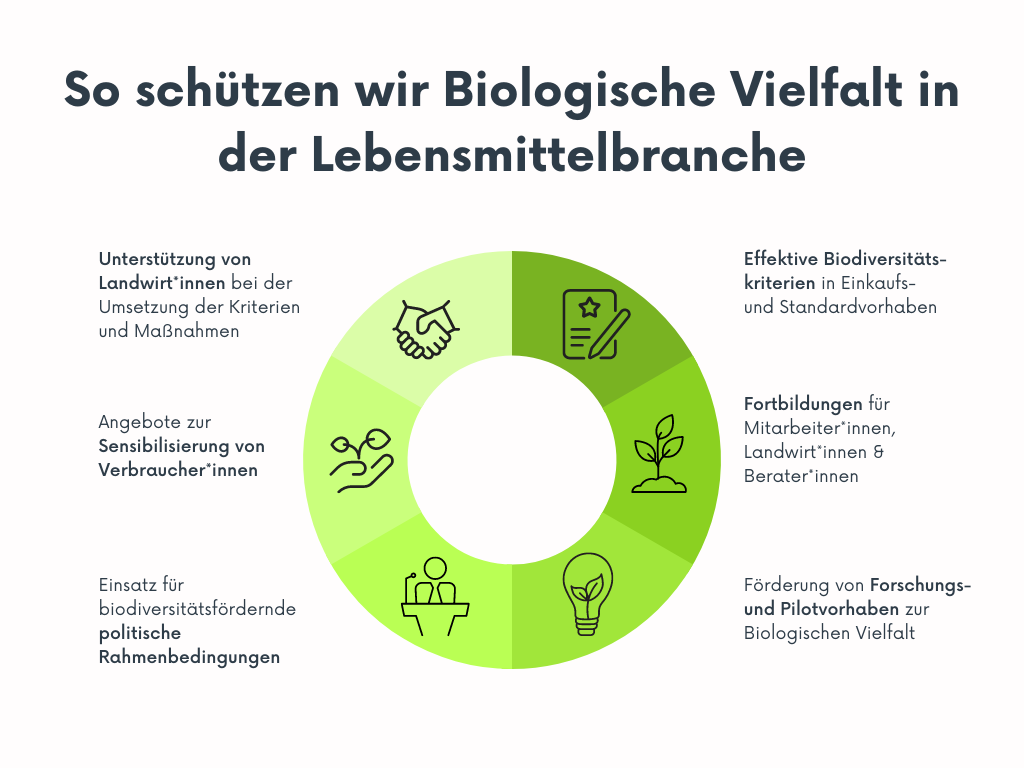
Providing guidance – with clear criteria
We develop and disseminate basic sets of biodiversity criteria—practical foundations for agricultural production, biodiversity-friendly procurement and food standards.
Implementing measures – effective and scalable
We start with concrete pilot projects and systematically transfer successfully tested biodiversity measures to additional commodities and supply chains—enabling companies to achieve measurable improvements step by step.
Strengthening collaboration – cross-sector & solution-oriented
In our working groups and events, companies, retailers, standards bodies and civil society connect to share knowledge and jointly further develop biodiversity criteria.
Creating incentives – making biodiversity economically attractive
We develop concepts to promote biodiversity-friendly business practices—e.g., through market-based incentive models and partnerships with standards bodies and financial actors.
Shaping framework conditions – politically and strategically
We advocate coherent, practicable regulation that strengthens biodiversity and provides companies with planning certainty—at German, European and international level.
Vision
The food sector in Germany and Europe has recognised the value of biodiversity and has taken comprehensive measures to protect and promote biological diversity. Sector stakeholders work largely together on initiatives—especially on activities to improve biodiversity performance in the cultivation and/or production of agricultural raw materials. Successful solutions are rolled out across supply chains, and farmers are supported in implementing measures through cost-covering prices and other attractive incentives.
Mission
Food for Biodiversity supports stakeholders in the food sector in integrating biodiversity protection effectively and in an economically viable way into their strategies, processes and supply chains. With ambitious requirements, practical tools, joint initiatives and a strong network, we contribute to measurable progress and credible communication.
Goals 2025–2027
In the strategy developed jointly with the members, the association’s goals and activities for the period 2025 to 2027 were defined. The agreed measures help stakeholders in the food sector improve the protection of biological diversity at various levels and thereby contribute to Food for Biodiversity’s mission. The following fields of action will be addressed:
The basic set of biodiversity criteria for the food sector is an important foundation of the association. It is intended to serve as a guideline for standards organisations, companies and producer groups to assess and, where necessary, adapt their standards and requirements. Measures:
- A strategy for comprehensive consideration of the basic set will be developed and implemented by FfB members. The strategy defines the stakeholder groups, the risk commodities and their supply chains, when the basic set is considered to have been taken into account, and how this is documented. The roll-out strategy is to be adopted in spring 2026.
- By the end of 2026, six commodity-specific basic sets of biodiversity criteria will be developed.
- New members will implement a pilot project to familiarise themselves with taking the basic set criteria into account.
In addition to public funding, incentives from food companies are important to scale biodiversity protection. Measures:
- A case study on incentives to improve biodiversity performance in food companies will be carried out. The results will feed into a guideline as well as video clips on successful incentive systems. Timeline: mid-2026.
- Together with industry associations, sector solutions for incentive systems will be developed and promoted among members (e.g., an incentive programme for dairies or for viticulture). Timeline: end of 2027.
Many different tools support farms and food companies in managing aspects of biodiversity. These include tools that describe the baseline situation on the farm and provide input for a management plan, tools for identifying and assessing risks and dependencies, life-cycle assessments for products, or tools for monitoring biodiversity.
- Preparation of an overview of existing tools, their objectives and possible applications. Recommendations for food companies, as well as for farms and standards organisations, on which tools are suitable for which tasks. Timeline: autumn 2026.
- To enable meaningful biodiversity monitoring, we will develop a framework that serves as guidance for stakeholders in the food sector. The framework includes structures, processes, as well as metrics and indicators. Timeline: end of 2027.
Buyers, quality and product managers, supply chain and marketing managers should understand the importance of biodiversity for the sector and take the protection of biological diversity into account in their decisions. Since its establishment, the association has successfully delivered professional development and training modules for employees in food companies together with the Federation of the German Food and Drink Industries (BVE) and the German Retail Association for Food (BVLH).
- The training modules are updated regularly, and food companies and associations are encouraged to implement the content of the training.
- Together with the BVE, a guide “Biodiversity in the food sector” will be developed and published. Timeline: early 2025.
- Exchange with training institutions will be intensified in order to embed biodiversity training in their programmes. Timeline: ongoing.
Auditors and statutory auditors with strong knowledge of the biodiversity field of action can competently support companies in producing substantive reporting. Independently of advisory services, they also have a better basis for the validation/certification of environmental and sustainability reports.
- Three virtual training modules on biodiversity in the food sector will be developed. Timeline: June 2025.
- Together with the Environmental Verifiers Committee, the DAU (German Accreditation and Licensing Body for Environmental Verifiers Ltd.), as well as large and mid-sized audit firms and training institutions, virtual training courses will be offered. Timeline: ongoing.
The IPBES reports 2019 and 2026, as well as numerous other studies, show that many ecosystems worldwide have already been destroyed or severely degraded. A central goal of the CBD Kunming–Montreal Global Biodiversity Framework (KMGBF) is to restore at least 30% of degraded ecosystems by 2030. In the EU, the EU Nature Restoration Law has been in force since June 2024. The estimated global financing need of up to USD 700 billion per year is currently covered by only around 20%. The private sector must be involved in financing to even come close to achieving the goals. Measures:
- Various methods and systems for financing ecosystem restoration—especially biodiversity credit systems—will be analysed (type of projects, scope, processes, monitoring, costs, etc.). Timeline: mid-2026.
- Assessment of the expectations and requirements of the food sector regarding projects financed via biodiversity credits. Timeline: end of 2026.
- Exchange with NGOs and other coordinators of restoration projects on biodiversity credits (requirements, success factors, etc.). Timeline: spring 2027.
- Encouraging stakeholders in the food sector to finance insetting projects for ecosystem restoration via biodiversity credits or other routes. Timeline: from end of 2026 – ongoing.
Food for Biodiversity offers stakeholders in the food sector a platform for professional development, exchange of experience and joint activities. Measures:
- Regular professional development events for the food sector as well as webinars for exchanging experience. Timeline: ongoing.
- European conference in Brussels on current biodiversity issues. Target groups are stakeholders in the food sector including agricultural suppliers, policy-makers, research institutes and NGOs, coordinators of business & biodiversity initiatives and international networks. Timeline: October 2026.
- Support for establishing FfB initiatives in other EU countries (toolkit, joint activities, etc.). Timeline: ongoing.
- Participation and presentations at trade fairs and events in the food sector. Timeline: ongoing.
- Support for trade media and strengthening presence on social media, especially LinkedIn. Timeline: ongoing.
We advocate coherent, practicable regulation that strengthens biodiversity and provides companies with planning certainty—at German, European and international level. Measures:
- Exchange with German environment and agriculture ministries at state and federal level. Timeline: ongoing.
- Exchange at European level with the Directorate-General for Agriculture and Rural Development (DG AGRI), the Directorate-General for Environment (DG ENV), and the Directorate-General for Health and Food Safety (DG SANTE).
- FfB is a member of the EU Business & Biodiversity Platform.
- Committed member of the UBi supporter group (Unternehmen Biologische Vielfalt).